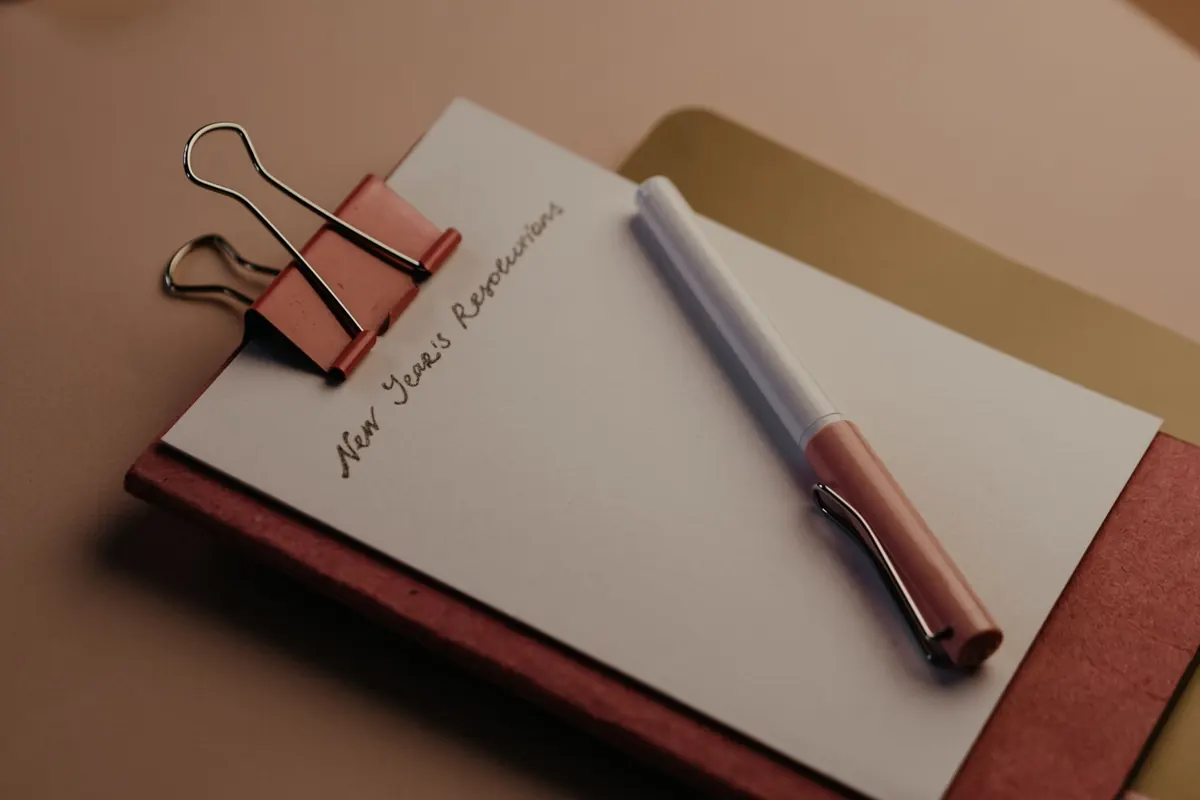
You do not need an empty hour, a leather-bound notebook, or a quiet morning with the curtains open. You need five minutes and something to write with. That is the whole requirement.
Most people who abandon a journal do so because they set the bar somewhere their real week cannot reach. They imagine two pages of reflection on a Tuesday night, manage it once, then skip three days, then feel behind, then stop. The fix is not more discipline. It is a smaller entry.
Five minutes is short enough to survive a bad Wednesday and long enough to hold something worth keeping. Here is how to build the habit from scratch.
Why five minutes is enough
A journal earns its value through repetition, not through length. Ten careful lines written on most days gives you a record you can actually read back: what your week felt like, what you were worried about in March, what changed. Two pages written twice a year gives you two nice afternoons and no record at all.
Short entries are also easier to reread, which is where the real benefit appears. Flipping through a month of five-minute entries takes four minutes. Flipping through a month of dense essays takes an evening you will never find.
And there is a practical bonus: the shorter the promise, the harder it is to break honestly. "I did not have five minutes" is a much rarer sentence than "I did not have forty."
Decide when it happens, by attaching it to something
Do not schedule the journal at "the end of the day." End of the day is a rumour. Attach the five minutes to something that already happens without fail.
- After the kettle boils. Write while the tea steeps. The five minutes ends when the mug is empty.
- After you close your laptop. Before you stand up, before the kitchen, before the phone.
- Before you turn off the bedside lamp. Notebook on the nightstand, pen clipped to it.
- On the commute, if you get a seat. Phone notes app, one entry per day, same file every time.
Choose one trigger and write it down somewhere you will see it for the first week. Place matters too: keep the notebook and pen in the spot where you will use them, not in a drawer that requires a decision. If you write on your phone, pin the note or move the app to your home screen so it takes one tap instead of four.
A simple five-minute structure
Blank pages are the enemy of a short habit. Use the same four steps every day until they stop requiring thought.
- One line of fact. What happened that would otherwise vanish? Not the meaning yet, just the record. "Bus late. Meeting moved to Thursday. Bought peaches on the way home."
- One sentence underneath. Pick the fact that still has a bit of charge in it and say why. "The peaches were the best part of the day, because nobody asked me anything in the fruit shop."
- One small move. A single next step, or one thing you are putting down. "Text Marco back before ten." Or: "Stop rereading the email."
- One closing line. Something you are glad about, or simply "That's enough for today." The closing line is what stops the entry from spilling into the evening.
Written out, an entry might be a date and four lines. That is a complete entry. Nothing is missing.
If you have three minutes instead of five, do steps one and two only. If you have sixty seconds, do step one.
Keep the tools boring on purpose
The fastest way to lose this habit is to spend a week choosing a notebook. Pick something cheap and small enough to carry, or pick the notes app you already use. Then stop shopping.
Keep every entry in the same place, in order, with the date at the top. No backfilling last week, no themed sections, no decorations. A journal that is slightly dull to look at is one you will keep writing in, because it never asks you to make a decision first.
Write for yourself, not for a future reader. Half-sentences are fine. Bad handwriting is fine. You are the only person who will ever need to read it, and you will recognise your own shortcuts.
For the days when it falls apart
Some days there is no five minutes. Not because you were busy being productive, but because the day was the kind that eats everything. Plan for those now, while you are calm.
- The two-line version. What happened, how it felt. Done.
- The list version. Three bullets: one thing done, one thing unfinished, one thing that helped.
- The next-morning version. Write yesterday's line before today's. One sentence is enough; do not try to reconstruct the whole day.
- The honest skip. Write the date and the word "skipped." The chain stays intact, and the page does not become a monument to failure.
Missing a day is not a broken habit. Missing eight days usually is, and those eight days almost always start with one missed day that felt too shameful to write after. Lower the bar immediately instead.
Getting past the third week
Novelty carries you for about a fortnight. After that the habit needs two things: a promise that stays small, and a reason to look back.
Resist the urge to grow the routine. Do not move from five minutes to twenty because five suddenly feels easy. Five minutes that happens six days a week is worth more than twenty minutes that happens twice, and the easier version is what gets you through a heavy month.
Once a week, on a Sunday or whenever you have three spare minutes, read back over the last seven entries. Not to judge them. Just to notice what repeats: the same worry, the same person, the same good part of the day. That is the part most people never reach, because they quit before there is anything to reread.
If the blank page still feels loud, keep this list of openers nearby.
- What did I avoid today?
- What was the smallest good thing?
- What am I carrying into tomorrow that I could put down?
- Who did I speak to, and what did I actually think about it?
- What did I notice today that I would have missed a year ago?
Your first seven days
Tonight, pick your trigger and put the pen where the trigger happens. For the first week, write one line of fact and one sentence underneath, then stop. Do not add anything. On day four you will be tempted to write more; that is a good sign, but let it arrive on its own next week.
By day seven you should have seven dated entries, some of them four lines long and one of them the word "skipped." That is a working habit. Prompts, structures and rereading are refinement, not the foundation.
One more thing worth saying plainly: a journal is a good way to notice how you are doing, but it is not a substitute for support when something is genuinely heavy. If the entries keep circling the same hard thing, talk to someone qualified, whether a doctor, a therapist, or a trusted person who can help you find one.
Photo: StockSnap / Pixabay