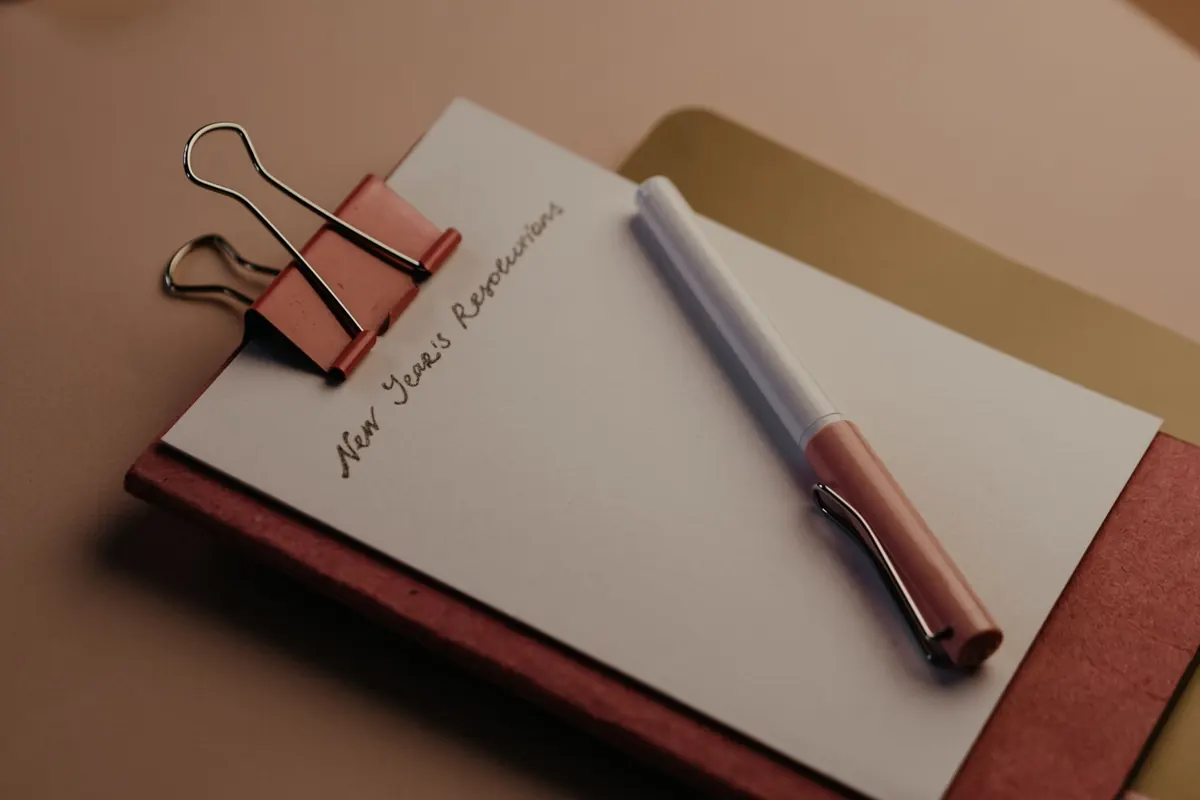
A notebook by the bed, a pen clipped to the cover, and a promise to write every night. That is how a lot of journals begin — and, three weeks later, how a lot of them stall. The blank page asks a great deal: the whole day, in order, with feeling. A gratitude log asks something much smaller, and partly for that reason, people tend to keep it going.
The two forms get confused constantly. People start a gratitude log expecting a diary, or abandon a diary because what they actually wanted was a log. They are different tools with different jobs, and knowing which one you are holding makes both easier to use.
What a Gratitude Log Actually Is
A gratitude log is a short, regular record of specific things that went well or that you were glad to have. Not the day's plot. Not an analysis of your feelings. Usually three to five lines, written in a minute or two, often at night but sometimes in the morning.
The defining feature is specificity, not sentiment. "My family" is a category. "My sister called at lunchtime just to ask how the interview went" is an entry. The first takes a second to write and is gone from memory by Friday. The second stays.
Formats vary more than people expect:
- Three numbered items per day in a small notebook
- One sentence a day in a notes app, date-stamped
- A single page per week, filled in whenever something occurs to you
- A running list on an index card kept by the kettle
None of these is more correct than the others. What matters is that the format is small enough to survive a bad Tuesday.
Where a Diary and a Gratitude Log Part Company
A diary is a narrative instrument. It follows time, records events, and gives you room to think out loud about what happened and why it unsettled you. It is chronological by nature and often long. Some days it is three sentences; some days it is three pages and a decision.
A gratitude log is a noticing instrument. It does not care what order the day happened in. It answers one question — what was good here? — and it is deliberately repetitive, because most good things are.
- Scope: a diary covers the day; a log covers a handful of moments from it.
- Length: diaries reward depth, logs reward brevity.
- Tone: a diary can hold complaint, confusion and grief; a log tilts toward what you want to keep.
- Structure: diaries are prose, logs are often lists.
- Rereading: a diary is read to remember your life; a log is read to remember your luck.
That last point is the one most people feel. Open an old diary and you re-enter the difficulty. Open an old gratitude log and you find a hundred small things that were fine at the time and that you had entirely forgotten: a good sandwich, a returned phone call, the first cold morning of October.
Why the Short Form Does So Much Work
Brevity is not laziness here. It is the mechanism. Because the entry is small, you can write one on a night when you are tired, annoyed and out of goodwill toward the day — which is exactly the night the practice earns its keep. A habit that only works on good days is not a habit.
Specificity does the rest. When you push past "grateful for my friends" into an actual moment, you do two things at once. You retrieve the memory in enough detail to feel it again, and you train your attention to notice the same kind of detail tomorrow. Week two is usually when people start catching things during the day and thinking, that goes in the log.
Then there is the rereading. A gratitude log gets more useful as it ages, because it is not a record of your problems. It is evidence that ordinary days contain good ones.
How to Keep One That Survives a Busy Week
- Attach it to something you already do. After you brush your teeth, while the coffee brews, before you plug in your phone. A fixed anchor beats a fixed time.
- Set the number in advance. Three items. Not "as many as I feel like", which becomes zero on hard nights.
- Write the detail, not the label. Trade "good day at work" for "Priya said the draft was clear".
- Let hard days be one line. "The neighbour carried my parcel in" is a complete entry. Nothing about the day has to be good overall.
- Keep the paper visible. A notebook in a drawer is a notebook you will not open. Nightstand, kettle, the desk where you sit.
- Read it back monthly. Fifteen minutes at the end of the month, ideally with a cup of something. This is where the log pays out.
Mistakes That Make It Feel Pointless
The most common failure is writing for an audience, even an imagined one. If every entry is something you would be comfortable posting publicly, you are probably keeping a highlights reel rather than a log. The useful entries are usually small, slightly embarrassing in their ordinariness, and specific to a Tuesday.
The second is letting it turn into a second diary. Three pages of reflection are fine, but that is a journal entry, and it needs forty minutes you do not have on a Thursday. Keep the log short on purpose and put the long thinking somewhere else.
The third is quitting after a gap. Two missed weeks undo nothing. Write one line tonight and carry on. Nobody is marking attendance.
One caveat worth stating plainly: a gratitude log is a small attention practice, not a treatment. If low mood, anxiety or grief is weighing on you, a list is not a substitute for talking to a doctor or a qualified counsellor. It can sit alongside real support; it cannot replace it.
When a Diary Serves You Better
Some things do not fit in a list. A decision you keep circling, a conflict you need to think through, a plan that needs untangling — these want pages, not bullet points. In a season of working something out, a diary is the better instrument and the log will feel like a distraction.
Most people who keep both land on a simple arrangement: the log at night, three lines; the diary on a Sunday, or whenever something needs space. Either can stand alone. Using one does not oblige you to the other.
Start With Three Lines Tonight
Put the date at the top. Write three specific things from today — small ones, real ones, the sort of thing you would never mention out loud. A decent mug. A conversation that went better than expected. The rain holding off until you got inside.
Do the same tomorrow. After two weeks, read back a page. If the practice is doing its job, you will notice two things: that the week held more than you remembered, and that you have started spotting entries before you sit down to write them. That second effect is the whole point.
Photo: Pexels / Pixabay